
Request a Call

<svg xmlns="http://www.w3.org/2000/svg" width=" 100%" height=" 100%" viewBox="0 0 59.783 59.783">
<g id="Project_Managers" data-name="Project Managers" transform="translate(0.63 0.63)">
<path id="Path_22887" data-name="Path 22887" d="M24.519,5.87a10,10,0,0,1,5.876,9.1v3.964H9.84V14.972a10,10,0,0,1,5.876-9.1" transform="translate(9.144 5.207)" fill="none" stroke="currentColor" stroke-linecap="round" stroke-linejoin="round" stroke-width="2.5"/>
<circle id="Ellipse_343" data-name="Ellipse 343" cx="5.776" cy="5.776" r="5.776" transform="translate(23.485 0.62)" fill="none" stroke="currentColor" stroke-linecap="round" stroke-linejoin="round" stroke-width="2.5"/>
<line id="Line_579" data-name="Line 579" y2="4.501" transform="translate(29.321 12.949)" fill="none" stroke="currentColor" stroke-linecap="round" stroke-linejoin="round" stroke-width="2.5"/>
<path id="Path_22888" data-name="Path 22888" d="M27.159,39.079H12.778A2.8,2.8,0,0,1,9.99,36.291v-13.9A2.8,2.8,0,0,1,12.778,19.6h14.38a2.8,2.8,0,0,1,2.788,2.788v13.9A2.8,2.8,0,0,1,27.159,39.079Z" transform="translate(9.293 18.823)" fill="none" stroke="currentColor" stroke-linecap="round" stroke-linejoin="round" stroke-width="2.5"/>
<path id="Path_22889" data-name="Path 22889" d="M32.334,39.079H26.378a2.8,2.8,0,0,1-2.788-2.788v-13.9A2.8,2.8,0,0,1,26.378,19.6h5.955a2.8,2.8,0,0,1,2.788,2.788v13.9A2.8,2.8,0,0,1,32.334,39.079Z" transform="translate(22.78 18.823)" fill="none" stroke="currentColor" stroke-linecap="round" stroke-linejoin="round" stroke-width="2.5"/>
<path id="Path_22890" data-name="Path 22890" d="M9.364,39.079H3.408A2.8,2.8,0,0,1,.62,36.291v-13.9A2.8,2.8,0,0,1,3.408,19.6H9.364a2.8,2.8,0,0,1,2.788,2.788v13.9A2.8,2.8,0,0,1,9.364,39.079Z" transform="translate(0 18.823)" fill="none" stroke="currentColor" stroke-linecap="round" stroke-linejoin="round" stroke-width="2.5"/>
<line id="Line_580" data-name="Line 580" y2="14.241" transform="translate(29.261 24.162)" fill="none" stroke="currentColor" stroke-linecap="round" stroke-linejoin="round" stroke-width="2.5"/>
<path id="Path_22891" data-name="Path 22891" d="M49.221,23.14V20.173a4.161,4.161,0,0,0-4.163-4.163H7.713A4.161,4.161,0,0,0,3.55,20.173V23.14" transform="translate(2.906 15.263)" fill="none" stroke="currentColor" stroke-linecap="round" stroke-linejoin="round" stroke-width="2.5"/>
</g>
</svg>
Do I need to hire an eLearning Project Manager?
An eLearning Project Manager ensures training initiatives run smoothly, stay on schedule, and remain on budget.


Web-based Learning That Engages Students in STEM Topics
How a web-based learning platform sponsored by the National Hockey League taps into teen passions, specifically video games and sports, for STEM learning.

The mission of teaching STEM skills through hockey is to show students that science exists all around them and how learning these skills can be applied to everyday life. High resolution graphics, captivating animations, and challenging game mechanics may draw them in, but classroom coaches (a.k.a., teachers) are also supported with real-time student score reports and supplemental, offline lesson plans.
Awards

Client
The National Hockey League sponsored this program.
Challenge
Over the past decade, the number of available workers with strong STEM skills (science, technology, engineering, and math) has not kept pace with the demand from the U.S. labor market. Studies suggest that teens lose interest in these critical topics by the tenth grade. Teachers have been facing an uphill struggle trying to compete for mindshare amidst the myriad of student activities and distractions. This program is a web-based learning platform sponsored by the National Hockey League built for teachers to leverage student interests (grades 5-7) outside the classroom and to change the content delivery mechanism from traditional in-class learning to one which taps into teen passions, specifically video games and sports.
Strategy & Solution
In this course, students manage 1 of 30 NHL teams and apply math and science principles in pursuit of the championship trophy.
By utilizing the exciting, fast-paced game of hockey, educators can bring real world applications for math and science directly into the classroom. In addition to being a highly spirited and competitive game, hockey is also a sport that naturally lends itself to scientific principles. In the game, students learn and then immediately apply 12 STEM concepts such as calculating average skating speed, determining passing angles, and measuring friction. The game encourages experimentation through play and hone problem solving skills that parallel the scientific process.
Overall, the mission of teaching STEM skills through hockey is to show students that science exists all around them and how learning these skills can be applied to everyday life. High resolution graphics, captivating animations, and challenging game mechanics may draw them in, but classroom coaches (a.k.a., teachers) are also supported with real-time student score reports and supplemental, offline lesson plans.
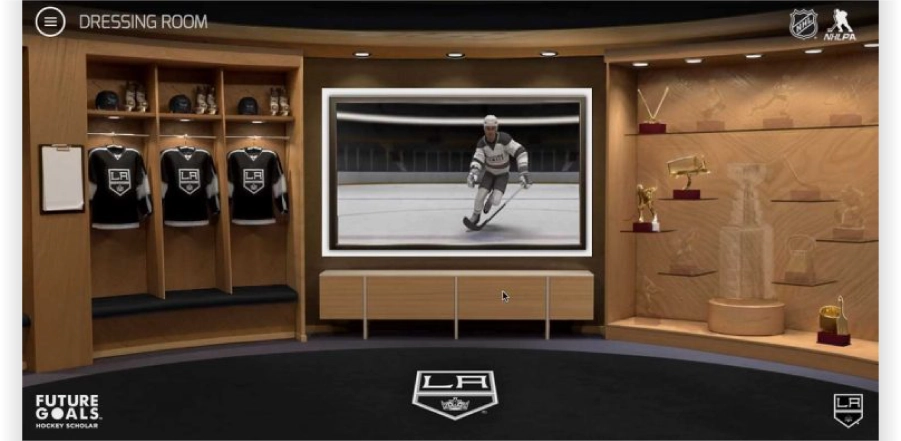
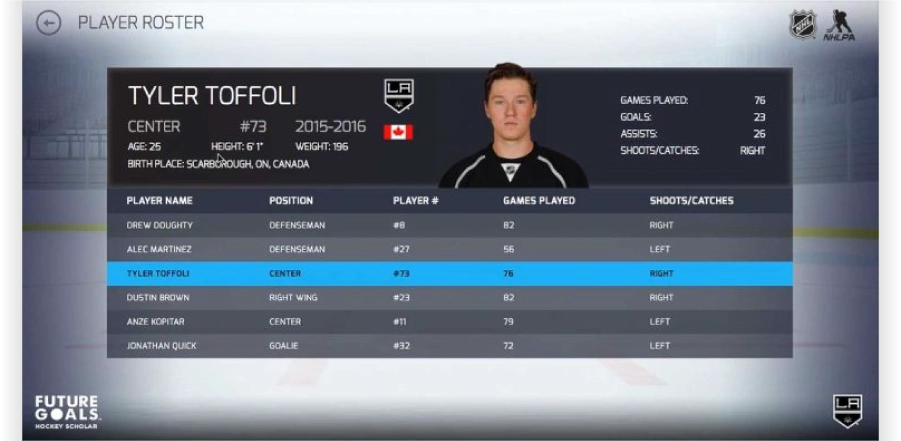
The game starts in a hockey dressing room. The dressing room represents the team uniforms according to the area where the student lives. Each section of the dressing room is clickable. The area where the jerseys are hanging takes you to the team’s starting line-up and stats. The clipboard on the wall accesses the “training center” which allows students to watch videos that explain the hockey concepts about which they are learning. This section also has downloadable pdfs for teachers to use as companion guides for in class follow-up work. The trophy case shows the student’s progress throughout the course. When a student completes a module, they receive a trophy. If the student completes all the games they win the Stanley Cup. The TV is the main portal to access the course games.
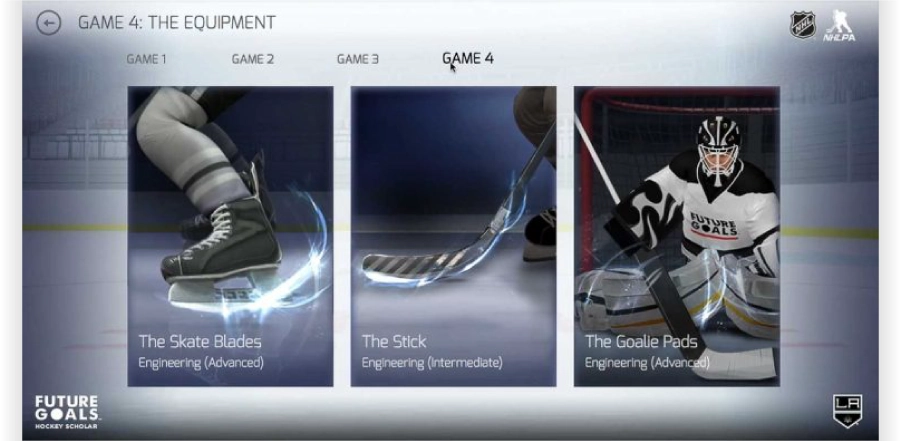
There are 4 games, and 3 activities within each game. They are as follows:
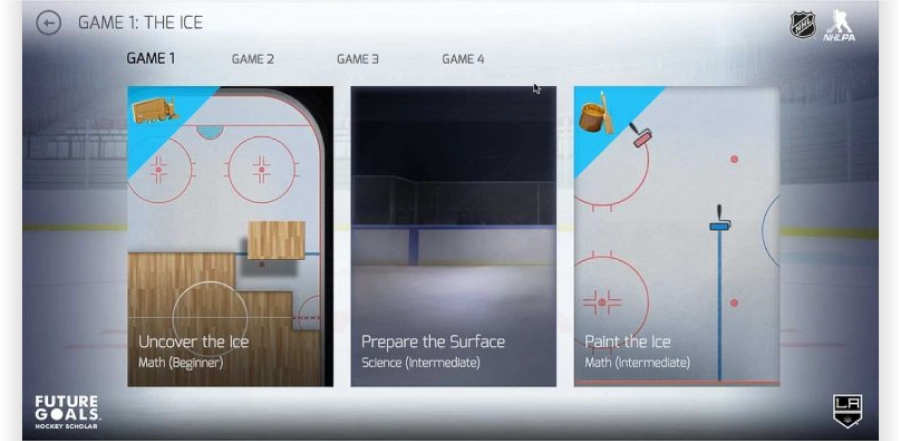
- Game 1 is all about the ice; the activities are called Uncover the Ice, Prepare the Surface, Paint the Ice
- Game 2 is about the final practice and centers on the Face Off, The Pass and The Shot
- Game 3 is all about the drills; the activities are called Speed, Strength and Endurance
- Game 4 is about the equipment and the activities are titled The Skate Blades, The Stick and The Goalie Pads.
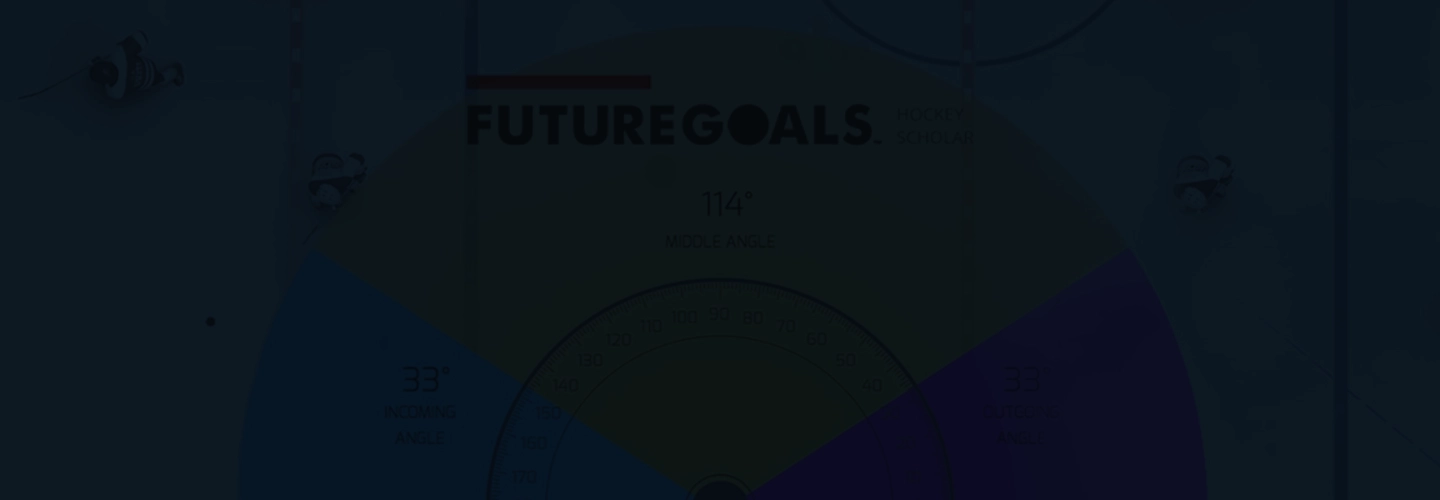
The Pass game teaches students about the “law of reflection” through a bank pass in the game of hockey. The game challenges students to pass to their teammates and measure the angles with the incoming and outgoing pass using a digital protractor.
Paint the Ice is another math module that teaches students about geometry and the coordinate plane. In this game, the student paints the ice to prepare for the “big game.” The student is challenged to paint the appropriate lines on the ice in the right length and size and on the correct coordinates.
The Skate Blades game is an engineering module that explores the concepts of independent and dependent variables. In hockey, players can sharpen their “radius of hollow” to different widths. The size of the radius of hollow affects their stopping distance. In this game, the student runs an experiment to understand how those two factors relate to one another.
Results
The games are intended to give students hands-on experience with math and science in the game of hockey to help them better understand the concepts and increase their knowledge retention.
Since its inception, this program has reached 3.2 million students who have logged over 7 million hours of learning.


Connect


