
Request a Call

<svg xmlns="http://www.w3.org/2000/svg" width=" 100%" height=" 100%" viewBox="0 0 59.783 59.783">
<g id="Project_Managers" data-name="Project Managers" transform="translate(0.63 0.63)">
<path id="Path_22887" data-name="Path 22887" d="M24.519,5.87a10,10,0,0,1,5.876,9.1v3.964H9.84V14.972a10,10,0,0,1,5.876-9.1" transform="translate(9.144 5.207)" fill="none" stroke="currentColor" stroke-linecap="round" stroke-linejoin="round" stroke-width="2.5"/>
<circle id="Ellipse_343" data-name="Ellipse 343" cx="5.776" cy="5.776" r="5.776" transform="translate(23.485 0.62)" fill="none" stroke="currentColor" stroke-linecap="round" stroke-linejoin="round" stroke-width="2.5"/>
<line id="Line_579" data-name="Line 579" y2="4.501" transform="translate(29.321 12.949)" fill="none" stroke="currentColor" stroke-linecap="round" stroke-linejoin="round" stroke-width="2.5"/>
<path id="Path_22888" data-name="Path 22888" d="M27.159,39.079H12.778A2.8,2.8,0,0,1,9.99,36.291v-13.9A2.8,2.8,0,0,1,12.778,19.6h14.38a2.8,2.8,0,0,1,2.788,2.788v13.9A2.8,2.8,0,0,1,27.159,39.079Z" transform="translate(9.293 18.823)" fill="none" stroke="currentColor" stroke-linecap="round" stroke-linejoin="round" stroke-width="2.5"/>
<path id="Path_22889" data-name="Path 22889" d="M32.334,39.079H26.378a2.8,2.8,0,0,1-2.788-2.788v-13.9A2.8,2.8,0,0,1,26.378,19.6h5.955a2.8,2.8,0,0,1,2.788,2.788v13.9A2.8,2.8,0,0,1,32.334,39.079Z" transform="translate(22.78 18.823)" fill="none" stroke="currentColor" stroke-linecap="round" stroke-linejoin="round" stroke-width="2.5"/>
<path id="Path_22890" data-name="Path 22890" d="M9.364,39.079H3.408A2.8,2.8,0,0,1,.62,36.291v-13.9A2.8,2.8,0,0,1,3.408,19.6H9.364a2.8,2.8,0,0,1,2.788,2.788v13.9A2.8,2.8,0,0,1,9.364,39.079Z" transform="translate(0 18.823)" fill="none" stroke="currentColor" stroke-linecap="round" stroke-linejoin="round" stroke-width="2.5"/>
<line id="Line_580" data-name="Line 580" y2="14.241" transform="translate(29.261 24.162)" fill="none" stroke="currentColor" stroke-linecap="round" stroke-linejoin="round" stroke-width="2.5"/>
<path id="Path_22891" data-name="Path 22891" d="M49.221,23.14V20.173a4.161,4.161,0,0,0-4.163-4.163H7.713A4.161,4.161,0,0,0,3.55,20.173V23.14" transform="translate(2.906 15.263)" fill="none" stroke="currentColor" stroke-linecap="round" stroke-linejoin="round" stroke-width="2.5"/>
</g>
</svg>
Do I need to hire an eLearning Project Manager?
An eLearning Project Manager ensures training initiatives run smoothly, stay on schedule, and remain on budget.


Middle School STEM Study Program for Careers in Healthcare
Helping middle school students hone skills and explore careers
Winner of a Silver 2019 International Serious PLAY Award!
Client
EVERFI is dedicated to helping organizations tackle intractable social issues by providing the missing layer of education. EVERFI leverages the combined power of their platform, people, and partner networks--like ELB Learning--to make sure learners have the tools and skills to drive ecosystems of change and inspire lifelong success.
Challenge
Along with our partner EVERFI, we developed this course to provide middle school students with a way to practice investigative and deductive skills while also learning about current medical technologies and careers in healthcare.
Strategy & Solution
Students adopt the role of a doctor at a walk-in clinic and diagnose and treat three different patients with varied medical concerns. They are encouraged to click around and explore the doctor’s exam room through the use of discoverable illustrations.
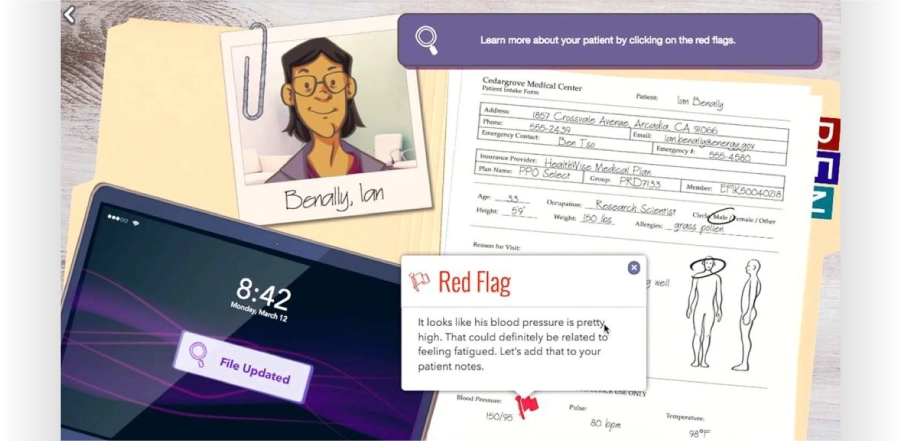
The module is organized into two parts. In the first part, the student experiences the initial consultation and learns about the importance of careful observation and listening to the patient. The second part, representing the follow-up appointment, allows the student to understand diagnosis and determining the course of treatment. In the initial consultation, students review the patient’s file for “red flags.” In the examination room, they will investigate the patient’s concerns with visual observation, patient interviews and physical examination using implements such as stethoscope, and reflex hammers.
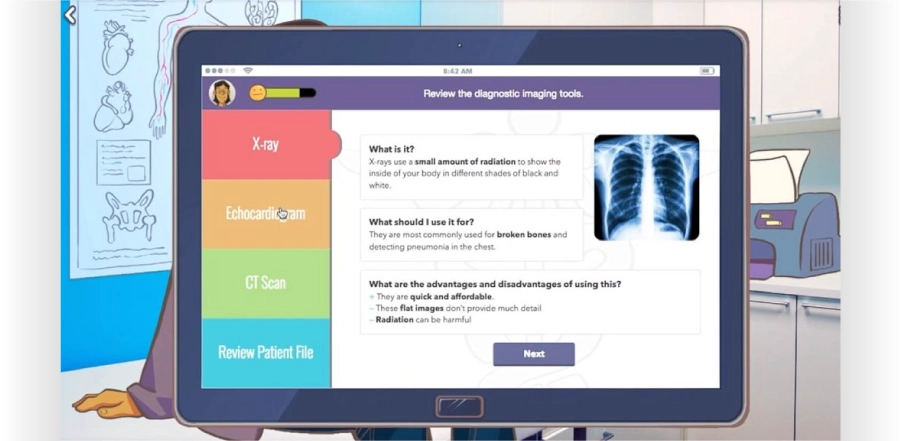
After the student has collected information on the patient, they are prompted to consider sending their patients for further examination using one one of three medical imaging technologies: X-ray, Echocardiogram or CT Scan.
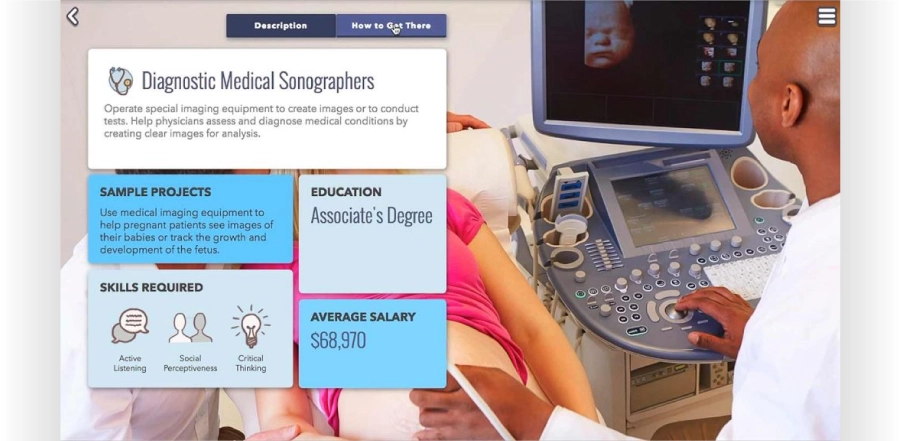
This process repeats for all three patients. As the student makes the correct decisions, the satisfaction meter of the patient increases. Within the module, the student is exposed to several careers in healthcare such as an actuary and ultrasound technician. They learn about the skills and degrees needed to obtain this position and the average salary.
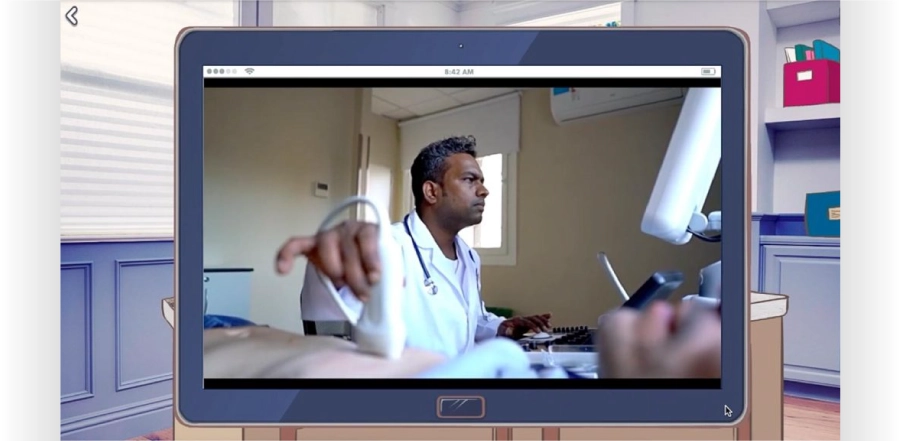
After the students have explored careers in healthcare, the second half of the experience ends with interpreting the results of the imaging. Students are shown a video of the relevant procedure in action and then given the results in the form of a “spot-the-differences” puzzle with the normal results on the left and the patient’s abnormal results on the right. When the student has spotted the abnormal portion of their patient’s results, they are guided through a short review of the treatment options available to them as a clinician (eg. sending the patient home for rest, treating them in their office or referring them to a specialist for their condition). This process repeats until all patients are satisfied with their treatment plan.
By going through this interactive experience, students are shown how doctors utilize observation and deduction to diagnose and treat their patients along with assistance from modern medical technologies. Guided whimsical role play demystifies the experience of seeing a doctor and empowers the student to consider a career in healthcare.
Results

Connect


