
Request a Call

<svg xmlns="http://www.w3.org/2000/svg" width=" 100%" height=" 100%" viewBox="0 0 59.783 59.783">
<g id="Project_Managers" data-name="Project Managers" transform="translate(0.63 0.63)">
<path id="Path_22887" data-name="Path 22887" d="M24.519,5.87a10,10,0,0,1,5.876,9.1v3.964H9.84V14.972a10,10,0,0,1,5.876-9.1" transform="translate(9.144 5.207)" fill="none" stroke="currentColor" stroke-linecap="round" stroke-linejoin="round" stroke-width="2.5"/>
<circle id="Ellipse_343" data-name="Ellipse 343" cx="5.776" cy="5.776" r="5.776" transform="translate(23.485 0.62)" fill="none" stroke="currentColor" stroke-linecap="round" stroke-linejoin="round" stroke-width="2.5"/>
<line id="Line_579" data-name="Line 579" y2="4.501" transform="translate(29.321 12.949)" fill="none" stroke="currentColor" stroke-linecap="round" stroke-linejoin="round" stroke-width="2.5"/>
<path id="Path_22888" data-name="Path 22888" d="M27.159,39.079H12.778A2.8,2.8,0,0,1,9.99,36.291v-13.9A2.8,2.8,0,0,1,12.778,19.6h14.38a2.8,2.8,0,0,1,2.788,2.788v13.9A2.8,2.8,0,0,1,27.159,39.079Z" transform="translate(9.293 18.823)" fill="none" stroke="currentColor" stroke-linecap="round" stroke-linejoin="round" stroke-width="2.5"/>
<path id="Path_22889" data-name="Path 22889" d="M32.334,39.079H26.378a2.8,2.8,0,0,1-2.788-2.788v-13.9A2.8,2.8,0,0,1,26.378,19.6h5.955a2.8,2.8,0,0,1,2.788,2.788v13.9A2.8,2.8,0,0,1,32.334,39.079Z" transform="translate(22.78 18.823)" fill="none" stroke="currentColor" stroke-linecap="round" stroke-linejoin="round" stroke-width="2.5"/>
<path id="Path_22890" data-name="Path 22890" d="M9.364,39.079H3.408A2.8,2.8,0,0,1,.62,36.291v-13.9A2.8,2.8,0,0,1,3.408,19.6H9.364a2.8,2.8,0,0,1,2.788,2.788v13.9A2.8,2.8,0,0,1,9.364,39.079Z" transform="translate(0 18.823)" fill="none" stroke="currentColor" stroke-linecap="round" stroke-linejoin="round" stroke-width="2.5"/>
<line id="Line_580" data-name="Line 580" y2="14.241" transform="translate(29.261 24.162)" fill="none" stroke="currentColor" stroke-linecap="round" stroke-linejoin="round" stroke-width="2.5"/>
<path id="Path_22891" data-name="Path 22891" d="M49.221,23.14V20.173a4.161,4.161,0,0,0-4.163-4.163H7.713A4.161,4.161,0,0,0,3.55,20.173V23.14" transform="translate(2.906 15.263)" fill="none" stroke="currentColor" stroke-linecap="round" stroke-linejoin="round" stroke-width="2.5"/>
</g>
</svg>
Do I need to hire an eLearning Project Manager?
An eLearning Project Manager ensures training initiatives run smoothly, stay on schedule, and remain on budget.


Middle School Financial Education
Using games to increase student's knowledge and give them the tools to create a better financial future.
Client
FutureSmart was created in partnership with a leading private-label, digital course platform dedicated to delivering a suite of content and services focused on scalability, activation, and multi-medium storytelling for learners from kindergarten through retirement.
Challenge
This course was created to provide middle school students in 6th-8th grade the tools required to make sound decisions about their financial future.
This course has reached over 2,455,567 students at 12,170 schools and 5,018,165 learning hours were logged. In a study done with 20,000 students who took this course, 90% saw a meaningful increase in knowledge. 50% of the students experienced an increase of 20 points or more in their score. Lastly, there was 20% more knowledge gained among the students taking this course than the control group.
Strategy & Solution
A University of Massachusetts Donahue Institute (UMDI) study, focused on this particular course, found that 90% of the students who took this course saw a significant increase in financial knowledge. In addition, 50% of the students saw an increase in the scores on their assessments by more than 20 points from the beginning of the course to the completion.
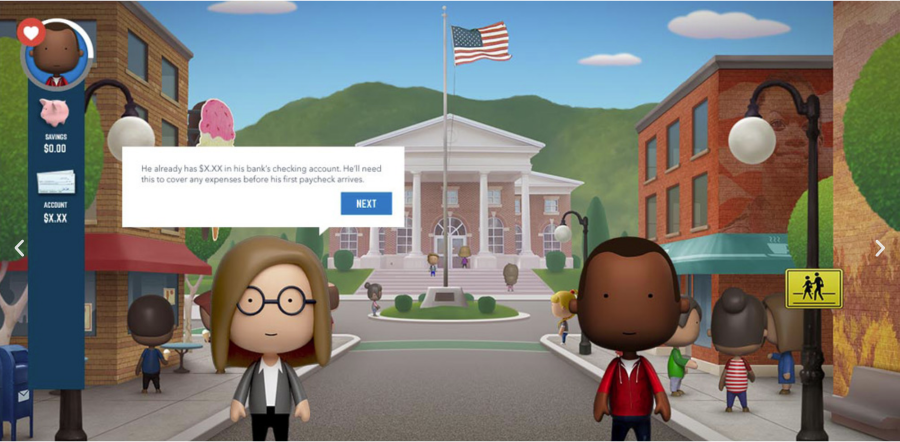
This course takes on a narrative approach and begins by assigning students the role of town mayor with the goal of helping citizens of the town make smart financial choices. The course consists of seven modules total, each containing lessons that are 20-25 minutes long.
In the first module, the narrative is introduced and the students are asked to reflect on financial values that are most important to them. This self-reflection is important for real-life application as well as the in-game narrative. The students then move onto personalizing their gaming experience by entering their name, the name of their town, and choosing their avatar.
Each module presents a different scenario follow a similar flow:
- Scenario set up
- Pre-assessment questions
- A series of decisions to make, with useful tips to help guide players
- At the end of each module, the student can see if they succeeded in making smart financial choices that mapped to their overall goal
When all modules are finished, students have the opportunity to build their own financial blueprint. They can re-examine the values they set in the first module and go through a series of exercises to map out how they can help themselves be set up for financial success.
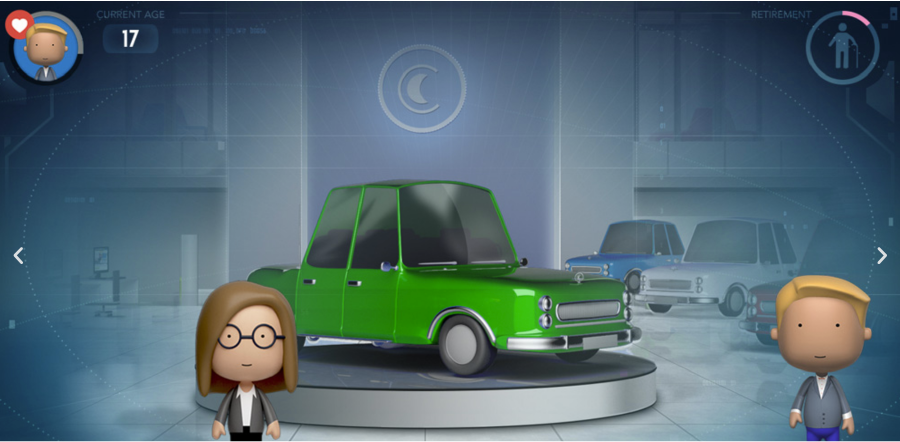
There is also a companion app available in the iOS and Google Play stores that simulates the personal and financial decisions an individual might make over their lifetime. There are 13 levels to the companion app, each pertaining to a different age and topic in order to simulate a range of scenarios.




Connect


